

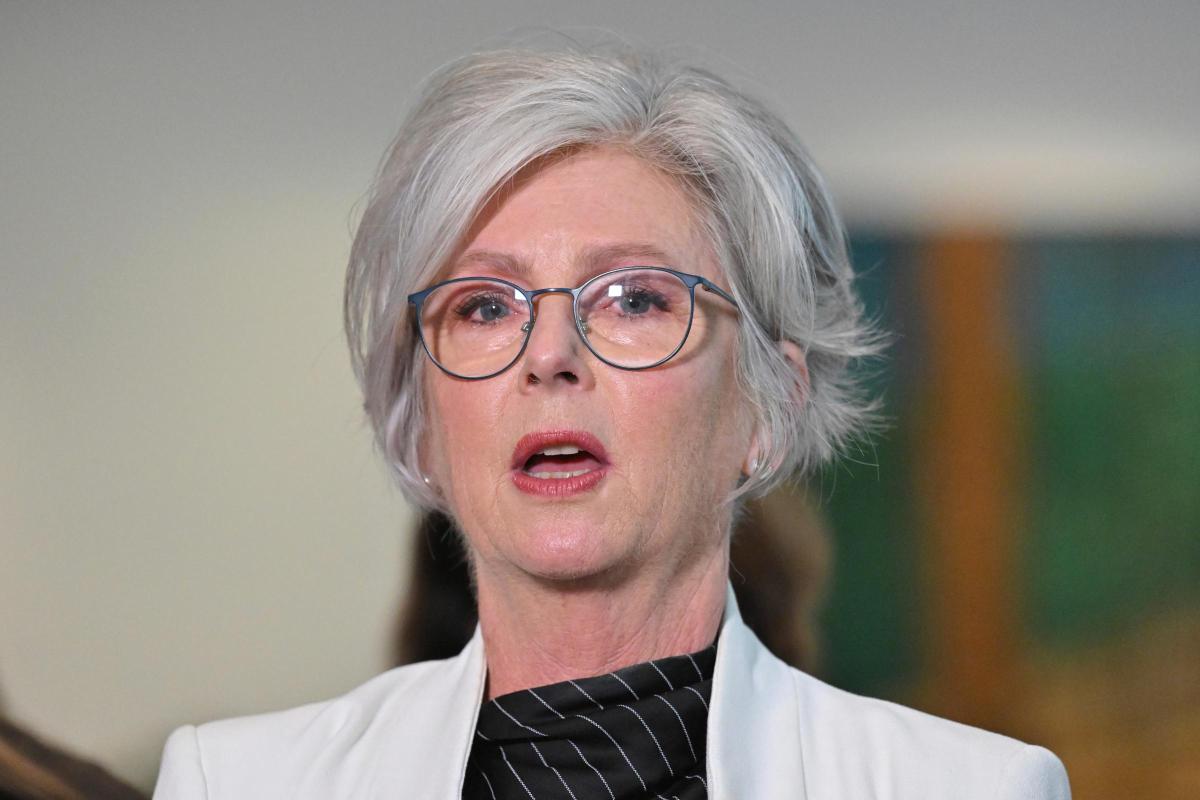

Doctors have amputated both of Australian politician Helen Haines’ legs as she remains in critical condition after being repeatedly hit by a car in an apparent act of political violence, her husband said.
The 65-year-old independent politician is receiving treatment in a Melbourne hospital where she was flown by helicopter.
Phil Haines, her husband, gave the family’s first public comments on her condition since she was hit by a Toyota Land Cruiser in her hometown of Wangaratta on Monday, speaking hours after a man accused of running her over made an initial appearance in court.
Ms Haines’ husband said her left leg was amputated on Monday and her right leg was amputated on Wednesday after doctors abandoned hope of saving it.
“The good news in all this is that Helen is alive and she’s stable. That is the most important thing for our family,” the husband told reporters in Melbourne.
“We are grateful and thankful that at this stage, both her heart and her mind are in good shape,” he said.
He added that their 40th wedding anniversary will be in November.

Earlier, Brendan Nugent, a 43-year-old man from nearby Tarrawingee, appeared in the Wangaratta Magistrates’ Court charged with intentionally causing serious injury, dangerous driving causing serious injury and causing harm to a federal official.
Nugent did not apply for bail or enter a plea. He will remain in custody until his next court appearance in February. Police have yet to determine a motive.
Nugent’s lawyer Chirag Patel told Magistrate Allison Vaughan that his client was suffering from potential mental health issues and a concussion. The lawyer did not explain how Nugent had been concussed.
Mr Patel said Nugent suffered from a neurological condition, idiopathic transverse myelitis, but had not been diagnosed with any mental health problems.
The rare condition damages the spinal cord’s protective myelin sheath and disrupts nerve signals between the brain and body.
This leads to rapid muscle weakness, sensory loss, pain, and bladder and bowel dysfunction, according to the Cleveland Clinic medical centre.
Witnesses say the driver rammed his victim, pinning her against her own car before reversing and ramming her a second time.
The well-regarded politician’s plight has shocked Australians, as political violence is uncommon in the country and politicians are highly accessible to the public.

Most politicians are not accompanied by security details and go about their work and personal lives on their own.
Senior opposition politician James Paterson on Wednesday called for a review of personal security in response to the alleged crime.
“The reality is that Australian parliamentarians by global standards are uniquely accessible to the public and that’s a good thing,” Mr Paterson told Australian Broadcasting Corp.
“But we … can’t have a situation where shocking attacks like this take place because that will fundamentally change our democracy forever if it becomes a serious risk to your life to be a member of parliament,” he added.
But Prime Minister Anthony Albanese urged politicians to continue to engage openly with the public despite worsening animosity within the community.
“We want to make sure that people can feel as much comfort as possible that everything’s being done to maximize security,” Mr Albanese told News24.
“I think parliamentarians across the board are determined to make sure that we can continue to engage as we need to in this great democracy of ours,” Mr Albanese added.
“That interaction is really important in our democracy.”

Politicians began online meetings with Australia’s security agencies on Wednesday to discuss their safety. Such briefings are a regular occurrence.
Mr Albanese described the briefings as an “opportunity for people who feel anxious to be able to ask questions” of security agencies.
Australian Federal Police provide personal security only to those politicians who are assessed as higher risk, usually because they have attracted the attention of dangerous people. Prime ministers always have personal protection and immigration ministers often do because they anger people with visa decisions.
Mr Paterson said providing police protection to all 226 federal lawmakers would not be practical. But he suggested increased security at electorate offices, such as Ms Haines’ office where she was hit.
Mr Paterson said politicians were “most identifiable” at their offices and that coming and going could be a “risky moment”.
Federal police commissioner Krissy Barrett told reporters that providing police protection to all parliamentarians would take an “incredible amount of resourcing”.
Police received 1,067 reports of threatening, harassing, nuisance and offensive communications against high officeholders including federal politicians and their office staff in the last fiscal year — a 12% increase on the previous year.
Ms Barrett said almost one suspect a week was charged over such threats.


Share